What did the retreat mean to me? It was a powerful experience, it showed me leadership, teamwork, and how we can connect to the world around us. I made connections from my life to nature, and created better relationships with some of my friends, as well as making new ones. It was a great experience and I'm very glad that I went. I found that the Katzie people were very interesting. I listened to great drumming and music.
What did I learn about myself? I learnt that I can shoot an arrow, paddle a canoe with my eyes closed, and be like Tarzan in the air. I learned how I'm a green. I learned how to be a leader. I also learned that in a team situation I work better when I listen and work off of the ideas of my teammates. I had a great time learning about what I can accomplish.
What connections to Science and Math did I find, or hear, or make with any experience that I had? I connected with watching the fish in the lake react with the frogs and the trees. To see an ecosystem up close and personal like that was amazing. It was great to see how the fish can live in the dead trees. I thought it was cool to see how all the mulch was because I know it had to be decomposed. I smelled the nature around me and could tell how pure and nice the oxygen was. I really enjoyed making these connections.
Bram Samuels, Grade 9, KDHS
28.10.10

8.10.10
Continuation of Notes
Pyramids:
A different period of numbers can look different.
Who lives in one big Oak tree: If a tree is 10 m high, with 10 birds in it. There needs to be lots of insects, for 10 birds. Weasel?.
1 Weasel
Some Birds
Lots of Bugs
1 Tree
(This is a pyramid of numbers)
Weasel
Birds
Insects
Tree
(This is a pyramid of biomass, with the heaviest on the bottom)
Backtrack:
Detrivores- An organism that obtains energy by eating dead organisms. Decomposers that live off of dead things are Detrivores. A decomposer that obtains energy from living things are technically parasites. An example is like a Fungus on a tree.
Cycling of Nutrients:
Carbon
Nitrogen
Phosphorous
(They are all cycles)
7.10.10
Food Web Notes
Food Chain:
Sun --> Wheat (Producer (Autotroph)) --> Mouse (Consumer (Heterotroph)) --> Cat (Consumer (Heterotrophs)) --> Wolf (Consumer (Heterotroph).
The word troph means feed. Wheat is at the first trophic level, mouse is at the second trophic level, etc. Mouse is a primary consumer, cat is a secondary consumer, wolf is a tertiary consumer.
If I have 1 Kg of wheat with an energy value of 1000 kJ. Wheat (1000 kJ) --> Mouse (100 kJ) --> Cat (10 kJ) --> Wolf (1 kJ). In a food chain the amount of energy available for the consumer in the trophic level above is 10%. The remaining 90% is used to live and grow. Heat is also emitted from your body.
Food Web:
A food web is composed of all of the feeding relationships in a community.
Herbivore --> Eats Producers ONLY (photosynthetic).
Carnivore --> Eats Consumers ONLY.
Omnivore --> Eats Producers and Consumers.
Pyramids of Energy (Numbers):
Level 4: Little: Hawk: 4th Trophic Level: 1
Level 3: A Bit: Snakes: 3rd Trophic Level: 365
Level 2: Some: Mice And Squirrels: 2nd Trophic Level: 266 450
Base: Lots: Plants And Grasses: 1st Trophic Level: 97 254 250
5.10.10
Ch. 2 Stuff part 2
Consumers: Cellular Respiration: Heterotroph (other eater).
I know it's not much but this is it.
Ch 2 Stuff Part 1
SUN -e-n-> PRODUCERS -e-n-> CONSUMERS -e-n-> DECOMPOSERS
carbon dioxide + water + energy = glucose + oxygen
Producers ---> Photosynthesis ---^> Auto- (self) trophs (feeding).
---> Chemosynthesis --------^> Occurs in ocean thermal vents (underwater hot springs) like this:
4.10.10
Ecosystems
Factors that affect/shape/mould an ecosystem?
What is ecology? Eco- means home, logy- means the study of.
An ecosystem is: The interplay of living and nonliving factors of where we live.
The Biomes are: 1. Boreal Forest (taiga), 2. Desert, 3. Tundra, 4. Grassland, 5. Temperate Rain Forest, 6. Tropical Rain Forest, 7. Temperate Deciduous, 8. (Permanent Ice(?)).
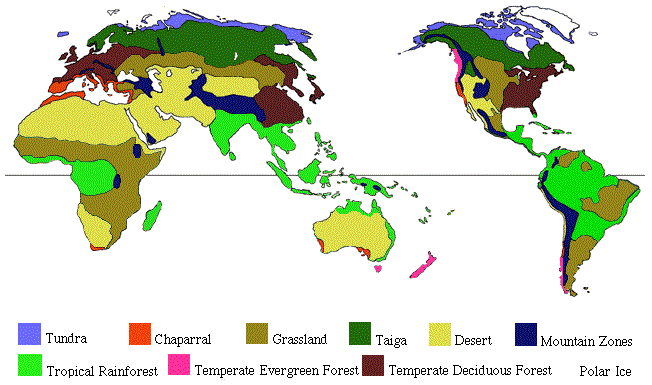
The first set of factors are abiotic (non-living): Temperature, rain, etc.
The second set of factors are biotic (living): Animal interactions, etc.
Abiotic: They are the factors that create the conditions of an ecosystem. They are: temperature, precipitation, latitude, elevation, proximity to large bodies of water, substrate and topography.
Biotic: They are the things that populate the ecosystems. They are the relationships between the plants, animals and bacteria in an ecosystems.
Abiotic Factors
The Abiotic factors that determine each biome are: temperature, precipitation, latitude, elevation, proximity to large bodies of water, substrate and topography.
Subscribe to:
Posts (Atom)